


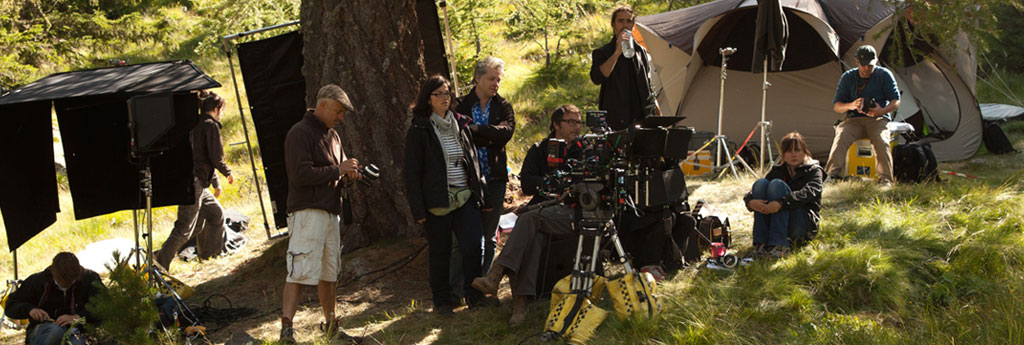



Whether it’s London, Paris or Berlin, the use of diesel generators is being
discontinued since restrictive environmental regulations have gone into force in many cities, especially in congested urban areas where diesel causes pollution. In London alone, 1,800 generators are in use for film and television productions, which produce 64,000 tons of CO2 per year. According to the Film London study ‘The Fuel Project, more than a third of traditional generators with Stage IIIa emissions standards are not permitted in the environmental zone anymore.
In France, the diesel ban has been tightened further. Starting on January 1, 2025, polluters that emit fine particulate matter and nitrogen oxides are banned from all conurbations with more than 150,000 residents.
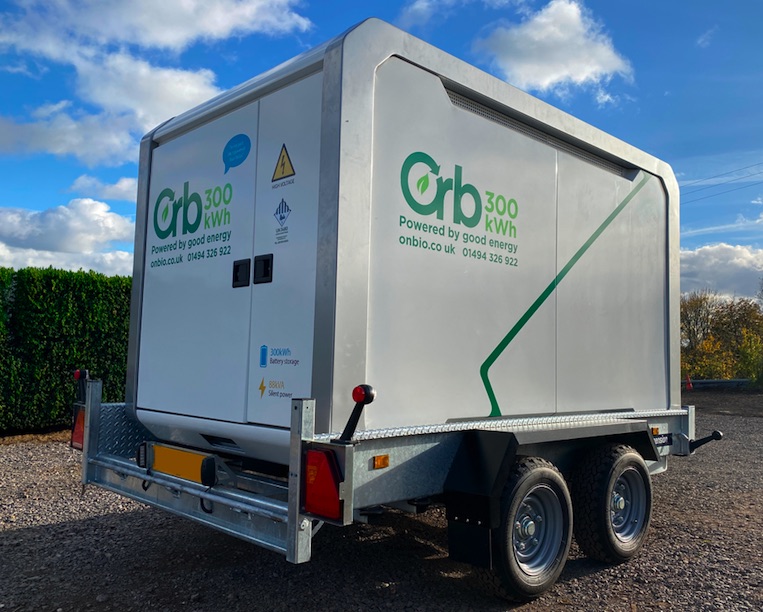 There are various battery systems with different power levels for the mobile power supply of film and television productions. In the UK, the film equipment rental company Onbio has developed a battery storage system with a capacity of 300 kWh. Four used Tesla automobile batteries are installed in the Orb 300, which provides a continuous energy supply of 29 kW. “When the storage capacity drops to 80 percent, the batteries are no longer used in vehicles, but they are perfectly suitable for power storage”, says Onbio CEO Tom Crooke. “Some batteries are almost brand new and have not even covered 10,000 miles, because they have been written off by the insurance company after minor accidents.” The charge status of the Orb 300 is shown on a display and can be called up via its website. A battery check app is also being developed.
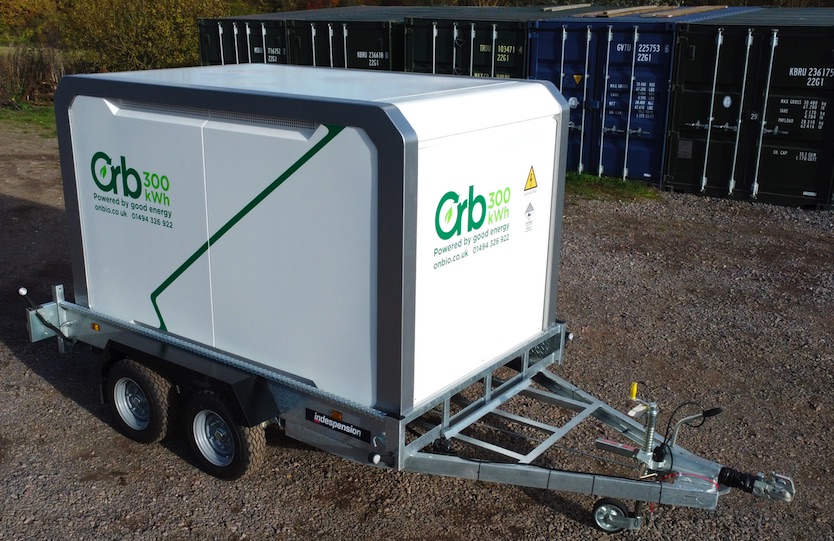 As part of the retrofit, it will also be possible to charge the Orb 300 at type 2 charging stations, which are becoming increasingly popular in cities. The battery can be fully charged in six hours at a 50 kW DC fast charging station. The Orb 300 prototype is initially being tested on a production for a streaming platform. With regard to growing environmental regulations, the longtime location manager expects to see an increasing demand for battery storage systems. “There are areas in central London where generators are no longer permitted. They are also not allowed to be operated with HVO because ultrafine particulate matter is also produced during combustion.”
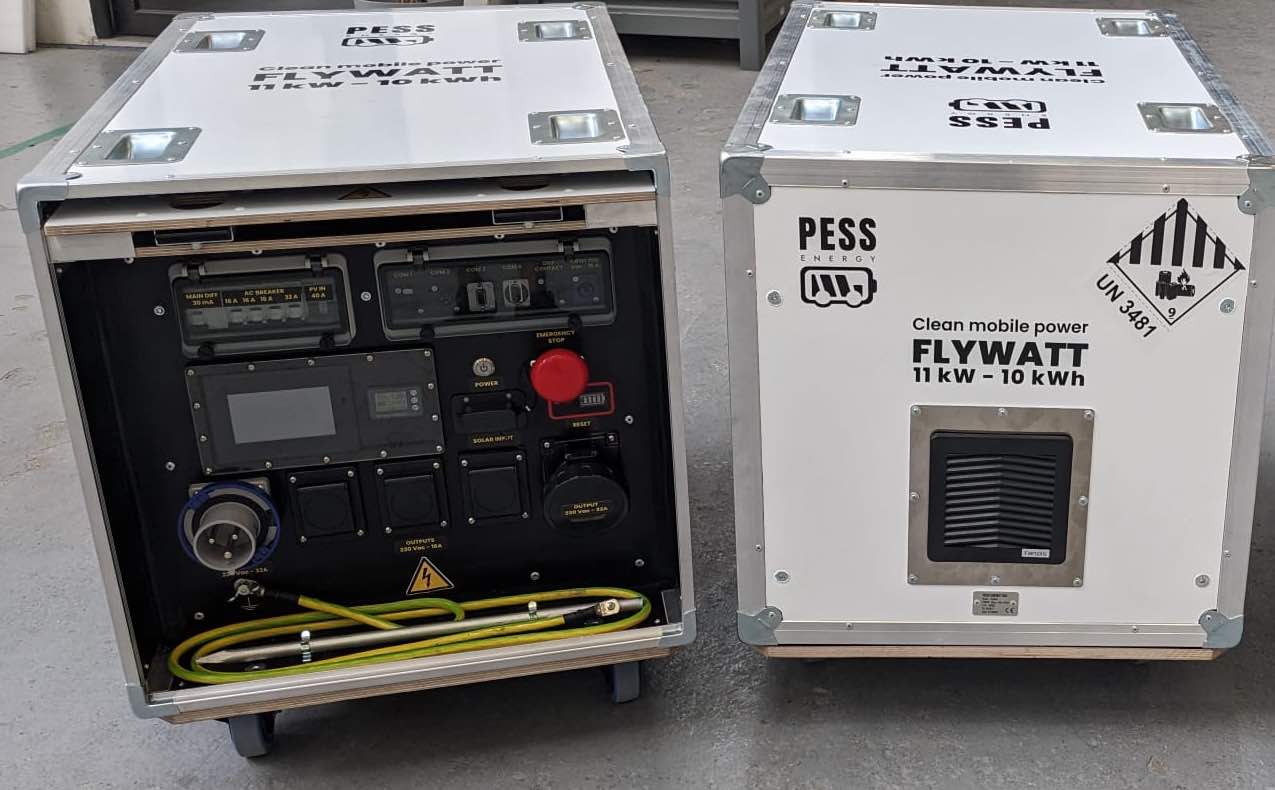 The French company Pess Energy already relied on the use of discarded batteries from electric cars when it developed the Bobine and Wattman power packs. “Many of our customers wanted a higher capacity, but they didn’t want a heavy, bulky battery”, says the company boss Rémi Pillot. “That’s why we created a new version with more power, in which the batteries are bundled and interconnected.” The 130 kg Flywatt nickel-manganese-cobalt battery has capacities of 11 kW and 10 kWh. Depending on requirements, two to six power storage units can be connected in parallel to supply a production of up to 60 kWh. Thanks to their stackable design, six units can be stowed in a delivery van and used as a compact modular solution for larger productions. Charging can take place at a 16 Amp home socket, a type 2 charging station, or a mobile solar panel.
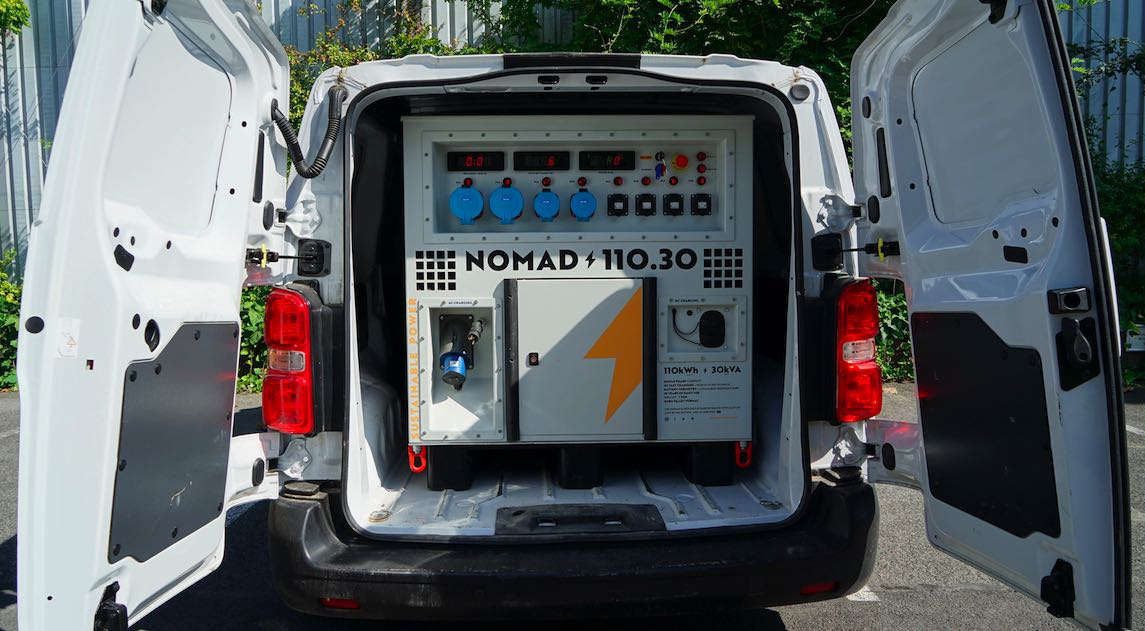 Meanwhile, the French company Nestor developed the Nomad, which has become a popular alternative to generators. “Since we presented this prototype a year ago, it has been booked almost every day for film shoots in Paris”, reports company founder Mathieu Cauvin, “because the use of diesel in the city center is being increasingly prohibited.” For its initial small production run of the Nomad110.30, the company has already received orders from France and Spain. The lithium iron phosphate battery, which weighs just under a ton, has a sophisticated battery management system for which the Nestor team developed the mechanical design and thermal management, as well as the assembly and welding processes.
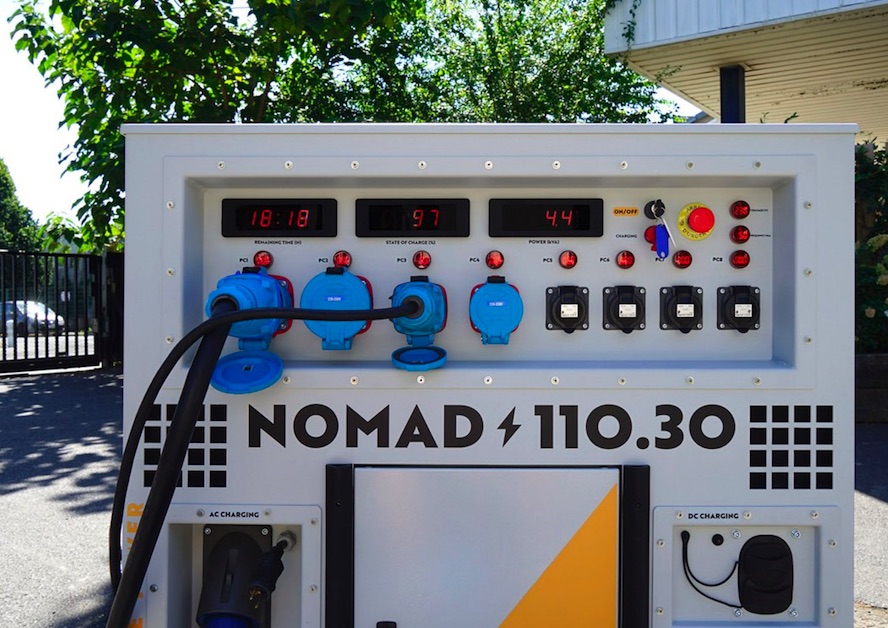 With a storage capacity of 109 kWh, the Nomad110.30 offers a continuous output of 30 kVA. It can be charged either at a household socket or at a charging station. At a 100 kW fast charging station, the Nomad110.30 can be charged from ten to 90 percent within an hour. The network connection and geolocation allow users to read their consumption and contact customer service directly.
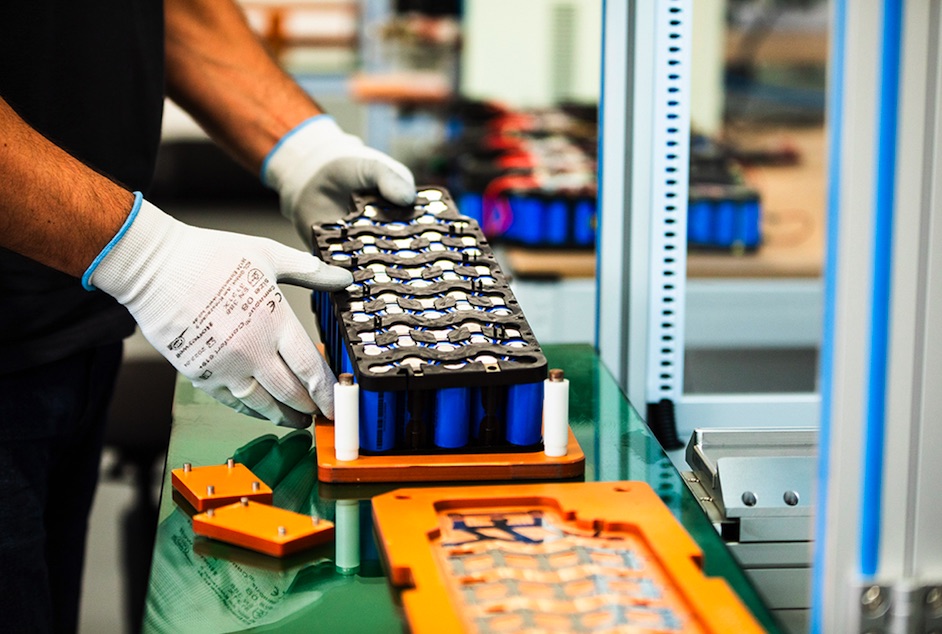 “Lithium iron phosphate batteries are much more thermally stable than other lithium-ion technologies, which greatly reduce the isk of overheating and thermal runaway”, explains Robert Mellinghoff, Head of Sales at the German company AES Akku Energie Systeme, which develops and produces battery systems and components for energy storage systems in Hamburg. “A LiFePO4 cell (LFP) weighs 20 percent more and has 20 percent less capacity than a nickel-manganese-cobalt cell (NMC). This initial disadvantage later turns out to be an advantage, because the cells are more stable thanks to their lower energy density.” Additionally, LFP batteries still retain a capacity of 80 percent after 3,000 charging cycles.
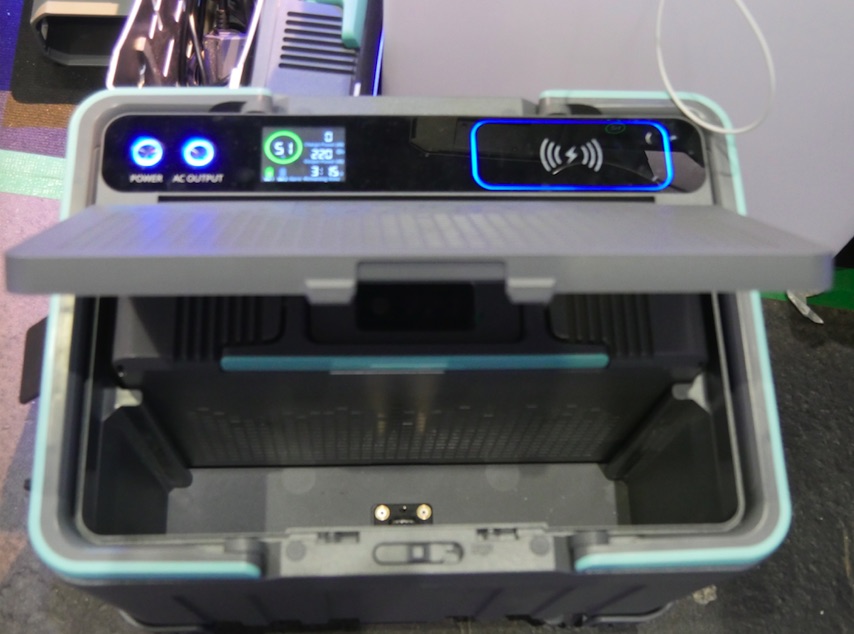 For a self-sufficient power supply, the manufacturer designed the AES power box, a modular system with two removable battery packs that delivers an output power of 2.3 kW. The interchangeable battery design of the power box, which also has a solar charging input, allows the fast scaling of capacities. The power box has already been tested on the set of the children’s crime series Die Pfefferkörner. Another variant of this power storage solution is the Energy Hub, which consists of four battery packs of 1.44 kWh. Each battery is interconnected and permanently installed in the vehicle.
Photos: © Adobe, Onbio, Pess Energy, Nestor, AES Akku Energie Systeme



 Robert Redford
 Arnold Schwarzenegger
 Hannes Jaenicke
 Nic Balthazar
 Nadeshda Brennicke, Actress
 Darren Aronofsky, Director, Noah / Jury President, 65th Berlin International Film Festival
 Tim Bevan
 Thekla Reuten
 Rachael Joy
 Nikola Rakocevi
 Nadja Schildknecht
 Michael Bully Herbig
 Lars Jessen
 Helen Hunt
 Douglas Trumbull
 Dieter Kosslick, Director Berlin International Film Festival
 Benoit Delhomme
 Jeremy Irons