


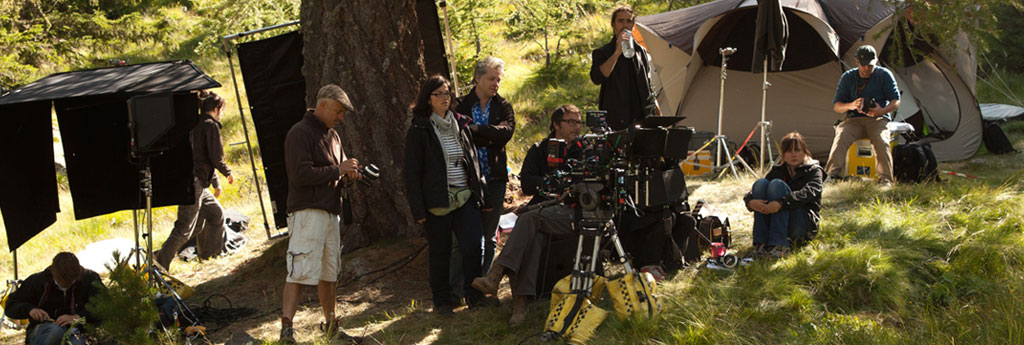


Fashion waste and circular design, sustainable agriculture, illegal logging in the Amazon as well as the environmental impact of plastic and toxins such as the ‘forever chemicals’ PFAS were among the topics in 26 feature films, documentaries, and animated films from all over the world at the Green Vision Potsdam festival, which is headed by former Berlinale director Dieter Kosslick. ‘Our approach is to see climate change differently, understand it better, retell it with films, knowledge and optimism”, emphasises Dieter Kosslick. The films are accompanied by experts and scientists who give an insight in complex coherencies.
 Moreover, the audience could check out various solutions at the ‘Market for Sustainable Living’, that was located in front of the Filmmuseum Potsdam, which served as the main venue for the four-day event, thattook place from May 22- 25, 2025. The bandwidth of services and products that were offered ranged from geothermal energy and plants from traditional seeds to organic food and drinks up to fair fashion clothing. In the documentary Responsible – There is No Business to be Done on a Broken Planet, French filmmakers Julien Demond and Tristan Lochon show sustainable companies that manage to work in a responsible way with people and our planet but also make profits.
 A mystical trip into the Amazon provides Pia Marais in her feature film Transamazonia which is based on a true story. A child is the only passenger who survived a plane crash and is saved by an indigene in the rain forest. As the daughter (Helena Zengel) of a missionary, she grows up in the jungle. When illegal logger menace the land of the indigenous people, the teenager’s allegiance to her father is shaken. “We shot for several months in Brazil and French-Guiana and were shocked how much of the Amazon is already destroyed”, says Pia Marais.
 As the Earth’s green lung, the Amazon plays a crucial role for the climate because it absorbs large amounts of carbon dioxide and produces oxygen. Professor Anders Levermann from Potsdam Institute for Climate Impact Research presented projections of the climate and environment up to the end of the century for different policy pathways. According to the scientists, sustainability will remain a critical issue for decades to come, but ambitious measures can achieve a situation at least similar to 2015 by 2050, and significantly improve it by 2100.
 Back in 1988, US vice president George H. W. Bush promised to actively tackle climate change until influential lobbyists prevailed, as documented in The White House Effect by Bonni Cohen, Pedro Kos, and on Shenk. Indeed, fossil fuels need to stay in the ground. While Germany is generating most of the electricity from renewables, Poland plans to build its first nuclear power plant. The controversial documentary Spaltung by João Pedro Prado and Anton Yaremchuk, who studied at the film university Babelsberg Konrad Wolf, is about a topic that is splitting nucleuses as well as the society.
 Besides the huge concerns how to deal with nuclear waste, there are further industries that pollute the planet. The Green Visions Potsdam opening film Dust to Dust by Kôsai Sekine shows that 92 million tons of old clothes are ending up in the landfills each year. Almost each part of plastic in clothes or single-use items breaks into tiny particles that get into the air, water, soil, and even in our bodies. The documentary Plastic People by Ben Addelman shows that embryos in the womb already take in synthetic materials. In addition to the absorption of plastic, all humans already have the ‘Forever chemicals’ PFAS in their bodies. These substances are used for food packaging, cosmetics, outdoor clothing, cookware, as well as fire foam. In the documentary How to Poison a Planet, Katrina McGowan takes a closer look at the environmental and health effects of these chemicals.
 In addition to raising awareness for critical topics, Green Visions Potsdam also presents solutions. The documentary Fungi: Web of Life gives a glimpse into the unknown world of fungi that prove it is possible to survive in a dramatically changing environment. The food of the future may be sourced from seaweed, which are inhabiting the planet since millions of years. The documentary Seaweed Stories by Jake Summer reveals solutions for a variety of challenges.
 “We invite films and people to Potsdam who show us alternatives”, underlines Dieter Kosslick. “This includes experts on circular economy, renewable energy sources, and ethical manufacturing as well as the booths at the ‘Market for Sustainable Living’ with useful tips for the everyday life.”
Photos: © PeterHimsel/Green Visions Potsdam; Periscope Films, Plastic Soup Foundation; Stephe Axford/Planet Fungi



 Robert Redford
 Arnold Schwarzenegger
 Hannes Jaenicke
 Nic Balthazar
 Nadeshda Brennicke, Actress
 Darren Aronofsky, Director, Noah / Jury President, 65th Berlin International Film Festival
 Tim Bevan
 Thekla Reuten
 Rachael Joy
 Nikola Rakocevi
 Nadja Schildknecht
 Michael Bully Herbig
 Lars Jessen
 Helen Hunt
 Douglas Trumbull
 Dieter Kosslick, Director Berlin International Film Festival
 Benoit Delhomme
 Jeremy Irons