


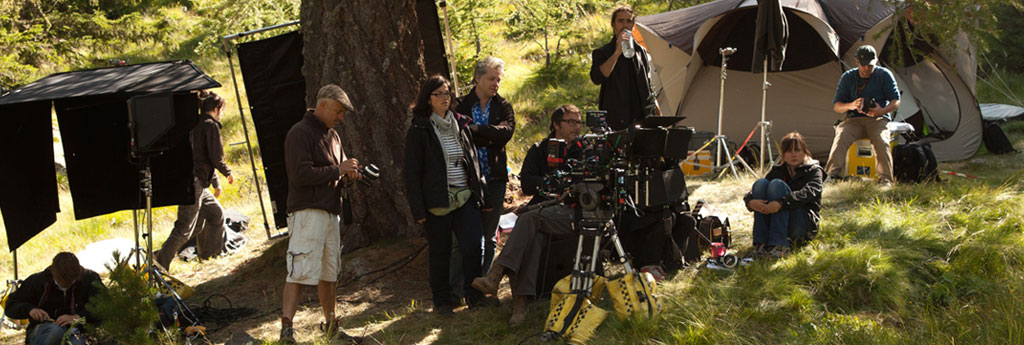


It is a real challenge to apply a zero flight policy to an international co-production, which needs to stay in budget. The Swedish producer and sustainability expert Ronny Fritsche set very ambitious goals when he produced the feature film Kevlar Soul. Kaisa Astikainen, a doctoral candidate at Aalto University, Finland, with a research topic of sustainability in filmmaking, presents a case study on the ecological production of Kevlar Soul.
 Ronny Fritsche is known in the Nordic audiovisual industry not just as a film producer, but as a sustainability expert, who has been working towards environmental awareness during the past ten years. His name is probably familiar to anyone who has participated in any film sustainability workshop, seminar or panel discussion in Scandinavia in recent years. He has been, for example, organizing the manifest, where 250 Swedish film workers protested against the film industry’s climate impact and co-founded the Nordic Eco Media Alliance (NEMA). Currently, he works as the Swedish CEO and Country Manager for the Norwegian Green Producers Club.
When the filmmaker Maria Eriksson-Hecht and screenwriter Pelle Rådström approached him with their idea, Fritsche was immediately captivated by the pitch and they started to develop the project together. From early on, Ronny Fritsche had a feeling that he didn’t want Kevlar Soul to become one of those “business as usual” – productions. “The film is about youth and giving them a fair chance in society”, he explains, “and we cannot do this film and be true to ourselves if we do it in an unsustainable, unecological way – then we will destroy their future."

In Kevlar Soul, two teenage brothers have formed a protective symbiosis in the absence of proper adult care in their lives. The strong bond between them is broken when one of them falls in love with a girl and his brother, feeling abandoned, is sent into freefall. Ronny Fritsche saw a chance to take his sustainability vision in this film to the next level and test a holistic ecological production model in practice. ”It motivated me to do a film with a social theme and also add this green layer to prove that a film -whatever the topic- could be made more sustainable” he says.
Fritsche knew screenwriter/director Maria Eriksson-Hecht from studying together at the Stockholm Academy of Dramatic Arts, where they made short films together. When the pitch of Kevlar Soul landed in his hands, he already had a long-standing collaboration with Zentropa Sweden, where he worked as a line producer and production manager on films such as The Here After by Magnus von Horn, and Another Round by Thomas Vinterberg. Kevlar Soul was his first film as a delegate producer.
Financing with an ecological mindset
Moving Sweden, a funding scheme aimed at first- or second time directors with low budget projects, granted the film a one-off development support, but when the script evolved, it was evident that the story would require a bigger budget. This led Ronny Fritsche to apply for funding from the main feature film support scheme instead. It started to look evident that the film would have to be an international co-production to reach a certain budget level.
 The Kevlar Soul project was selected to the Berlinale Talent Project Market, followed by the Cannes Co-Production Market. After an unsuccessful funding round in Denmark, Fritsche turned to other Nordic countries. Eventually, the film ended up as a Swedish-Finnish-Norwegian co-production,with Misha Jaari and Mark Lwoff co-producing for Bufo, Finland, and Verona Meier for Storm Films, Norway. Bufo already had some experience in sustainable production from Saara Saarela’s Memory of Water (2022) whereas Storm Film was more new to the topic: "This was my first time where all aspects of ecological production were taken really seriously and where the main producer was really committed to set a standard in green producing," says Verona Meier.
Sustainability was factored in the film funding applications from early on. "An exceptional thing is the way this production is financed with an ecological mindset” Ronny Fritsche believes that the project’s high environmental standards created a quality in the project and attracted interest from the funders. “I think that was a benefit for the financing – it made our project stand out in the very hard competition of other amazing scripts."
The development and financing of the film took almost five years. After eleven script versions, the project was greenlighted in January 2023, followed by support from Eurimages in June 2023. The total budget of the film came up to a bit more than two million euro, which is quite moderate for a Nordic co-production. Nordic film funders are still not asking for much ecological efforts of productions but they responded positively on his ambition and sustainability vision. Eurimages was the only funding body that asked in the application how the production is going to address sustainability.
Fritsche, as well as both minority co-producers point out how the whole co-production system is problematic from a sustainability point of view. Funding structures fragment the filmmaking process into many different countries and regions, and therefore lead to more emissions in the form of traveling and logistics. According to Misha Jaari "The problem is so big and so acute that it is almost a tabu. The system is built so that it does not take in consideration at all what a green production might need. In fact it makes everything more difficult." Verona Meier agrees:"Ideally, co-productions are as local as possible but unfortunately this is often not the case."
“Ecological filmmaking does not exist”
Ronny Fritsche drafted the first version of Kevlar Soul’s environmental policy already in the early financing stage. "It was stating that this is what I as a producer promise, if we get funding,” Fritsche says. "It created a great foundation, because it was read by Maria Eriksson-Hecht and Pelle Rådström, and it made my work transparent." This early sustainability pledge was updated over the course of the production, and communicated to partners, financiers, and to the crew early on. "It was an ambition to mention this in the early contact with people that should work on the project", says Fritsche, who included the "green pledge" in the production documents. “For example ‘no flying, we are taking trains’ was formulated in the work contracts, so people actually signed up on this as well.”
The environmental policy of Kevlar Soul was handed out to the crew in pre-production, which started in May 2023. This “green bible” consisted of sixteen steps in the categories of travel & transport, purchases, food, energy and waste. The policy also included actions of communicating about the environmental work to employees, contractors, partners and service providers. The travel and transport section included actions such as acquiring the most environmentally friendly rental cars possible, traveling longer distances by train or carpooling and avoiding flying altogether.
 Purchases were instructed to be made carefully, using eco-labelled and ethical products, minimizing the use of single-use items and refusing to buy single-use plastic items. Circularity was an important guideline: All purchases of props, costumes or location equipment were advised to be acquired from second hand, rental businesses or borrowed, and to be returned after use. As for catering, it was stated that all food provided by the production would be plant-based, and striving for organic, seasonal and as locally grown as possible. The energy section included using fixed power sources and requesting green eco-labelled electricity. The use of fossil fuel-powered generators was banned. Moreover, the production was going to manage its waste during all stages of production.
The crew was reminded to respect nature and the animals, and to constantly strive to improve environmental efforts. "This was the first production where I was the delegate producer, and I felt that, okay, now I can decide where I want to put the bar here”, emphasizes Fritsche. One big question was defining what environmentally sustainable production actually entailed. According to Fritsche’s definition, ecological production should have zero negative effect on the environment. “That means we could not use unsustainable energy sources while making it, or raw material or consume material that is produced in an unsustainable supply chain.”
Sustainable production design
Ronny Fritsche and Maria Eriksson-Hecht built their team of heads of departments around professionals who they knew from before, as well as some new acquaintances. Production designer Sanna Öhman Spjut was one of these “familiar faces”, coming into the production from the request of Maria Eriksson-Hecht, having previously worked together with her, Fritsche and cinematographer Josua Enblom. Sanna Öhman Spjuth never worked in a production where ecological issues were addressed to such an extent as in Kevlar Soul. “As a production designer you are on board very early on. In all the different presentations, meetings, everywhere… it was made very clear from the beginning that sustainability was something that the production, the producer, expected everybody to be aware about and to be cautious about”, she explains.
 The process of a production designer starts with reading the script and having discussions with the director, producer and other heads of departments, outlining the world, where the story takes place. Then the creative ideas are brought into a material level. “To me, ecological production is something very positive and necessary, especially in my department” Öhman Spjuth says, “because my department in particular could waste a lot of resources. We are buying stuff, producing stuff, building stuff…and we could be using materials or different kinds of processes that aren’t the best for the environment.”
In filmmaking a lot of the physical materials and resources go through the production design department. Therefore, just this one department could have a significant impact on the whole production’s environmental efforts. In the Nordic countries film productions have been implementing a circular economy simply due to budget restraints: set design and props have been acquired from second hand sources and by borrowing and renting. At the same time “dumping culture” -where goods and materials are thrown into trash after the shoot- has been strong. This is also because of budget reasons: If nobody has the hours to plan and execute the recycling of the materials, “dumping” is the fastest option.
 Refusing material consumption when creating a film set can seem like a radical act, but it was put into a test in the production of Kevlar Soul. Sanna Öhman Spjuth describes utilizing a lot of flea markets, auctions, and the SVT prop house, and finding for example all the wallpapers used from dead stock places. “We didn’t buy almost anything new” she notes. “Of course it differs, depending on what kind of movie you’re making, and what kind of props or things or places or sets, you need to do, or find, or make. Kevlar Soul happened to be the kind of script that allowed this kind of circular approach. The props, furniture and other materials were returned to different places in Norrköping and Stockholm after production wrapped. “The ecological option might not always be the most time efficient, the cheapest, or the most comfortable one, but it can be something that adds inspiration or originality" she sums up. "I just didn’t have the balls to put it in the budget."
In the Nordic countries, there are still only a handful of professional eco coordinators working in the audiovisual sector. In 2024 the first 19 certified eco coordinators graduated from the Green Consultant International online course. The biggest obstacle in hiring an eco-professional in the Nordic film industry might not be the lack of finding one, but rather being able to fit the position into the budget. Kevlar Soul ended up taking an eco-trainee, Jessica Tarland, to do her training under Fritsche’s supervision. Tarland had been working in the film industry since 2006 in the production design department, mainly handling props in various projects.
Even though Tarland was an experienced film worker, her new trainee role at Kevlar Soul didn’t come without struggles. Tarland thought her traineeship would be about thinking about ideas, how to develop sustainability work within the film industry, but instead, she found herself doing very practical hands-on tasks, such as keeping track of the loading of productions’ electric cars. She had a lot of conversations with Fritsche as well as the crew and did research on various topics.
Tarland emphasizes that proper planning in pre-production is the key to achieve a good outcome – especially when ecological thinking is added into the mix. In hindsight Tarland thinks that a closer dialogue about the tasks and expectations relating to the training would have benefitted the project. Ronny Fritsche agrees that having only an eco-trainee by his side was hardly ideal. He describes the conflict, feeling that he couldn’t cut the budget from the creative positions, in order to hire a professional eco manager. "I wish that I were brave enough to prioritize money on a full-time position”, says Fritsche because Tarland’s traineeship came to a planned end while filming was just halfway. The producer tried to cover the loss himself by taking care of the sustainability issues.
“Our film – like many or all film productions – faced extremely hard challenges. When having problems with everything, you as a producer need strength and energy to fix it.” When he needed a break smetimes, he would go and spend some time sorting the waste, creating a tutorial video on how to charge the electric cars, or making another phone call to find electronic vans in the region. “It gave me energy to go back and fix the ‘real’ problems of the production.”
Co-producing without airfares?
A zero flight policy was one of the key points in Kevlar Soul’s sustainability plan, even though it turned out to be a great challenge in the context of international co-production. Ronny Fritsche himself is known to be a producer who does not fly due to environmental reasons and for many years he promoted his initiative Festivaltåget – a campaign that inspires film industry people to take trains to Berlin and Cannes film festivals from Stockholm, by providing tailored travel instructions and nudging.
“Kevlar Soul might be the first feature of its kind that is financed with a fly-free workflow” Fritsche says. “And the process of film financing is highly carbon intensive, because a big part of the air travel takes place before the shooting period even begins” he points out. Producers travel from country to country to participate in different markets, co-production forums, talent labs, programs, and festivals, to develop the project, and to collect funding.
Fritsche contemplates that participating in many of these events might not always be necessary, but rather more about “keeping up appearances”. “I was so lucky this was a post-pandemic year and both Berlin and Cannes co-production forums were online editions” Fritsche explains, “- so I didn’t have to go there those years.” Later he travelled to Cannes, Les Arcs and Berlin by train.
 Due to the financing structure, Kevlar Soul had to have cast and crew coming to Sweden from both Norway and Finland, in different stages of production. “We did what we could to find crew and cast that were sort of easily located and willing to not fly during production,” Fritsche explains. “But this didn’t always work, and we had to compromise.” The ambitious zero flight aim was not met simply due to the fact, that the distances from northern Norway to Stockholm or crossing the sea from Sweden to Finland were not always possible to do without flying.
 "Taking trains instead of planes to the shooting and post- production has been no issue for short and well-connected distances such as Oslo-Stockholm or Oslo-Gothenburg", Verona Meier says, "but is was more difficult and not very practical to arrange for longer distances". Meier also points out the financial impact, which is simply that people get paid for travelling and the longer the journey, the more it costs. "I wonder how for example the train vs plane plays out if a co-production is more spread out, let’s say all over Europe or all over the world?" In the end there were less than ten airfares taken over the course of the whole production from funding to pre-production all the way to post-production, – a pretty remarkable achievement for a co-production of this size.
The electric car helpline
Artistic adjustment due to funding reasons are quite usual in filmmaking. The script of Kevlar Soul entailed one sequence where the young lovers travel abroad, which was solved by clever screenwriting. When the Danish funding fell through, the trip to Copenhagen  was re-written as a train ride from Stockholm to Hamburg, Germany. The train shot was filmed by a mini-unit film crew that actually hopped on to the train towards Germany and shot the scenes during the journey. "Business-as-usual would’ve probably been to shoot in a local train in Sweden and then fly to Hamburg to shoot there”, Ronny Fritsche says. “But I never even presented this as an option.” Fritsche talks about authenticity; how the actors were experiencing the journey for real, and this brought something into their performances as well. “Doing like this also saved us travel days”, Fritsche adds. “It was a positive side effect and cost efficient way of doing it, since we could both travel and film at the same time.”
As for cars, the production tried to use as many hundred percent electric vehicles as possible. But even finding the cars was a challenge: "There was no supplier in Norrköping that could rent out electric vehicles”, says Fritsche who needed to spend those costs in that region. After some phone calls and discussions with the car rental company, the requested vehicles were arranged into Norrköping for the crew to use. Supporting the team to use the electric cars and planning and arranging the infrastructure for charging, created a lot of extra work for eco-trainee Jessica Tarland. The user interface of the electric cars was so new to many of the film workers, that she had to set u a "helpline" to give the crew members charging directions and support for the use of the cars.
Sanna Öhman Spjuth admits that the production design department had some struggles with the electric vehicles, since they had to drive a lot, and the range just wasn’t always sufficient for their needs. “It took time, and it was frustrating”, Öhman Spjuth says. “In the end we actually had to swap some of the electrical cars into diesel cars, because it wasn’t possible to work with the electric cars.” Despite the problems, the production managed to favor mostly electric vehicles – a detailed bookkeeping shows that in the end sixtx percent of all the rental days were electric cars.
Fifty percent less emissions
 The shoot of Kevlar Soul began on the 8th of August 2023 and lasted for 32 days, plus some extra shooting days in the fall. Post-production was done during 2024 in Norway, Sweden and Finland. Due to the fact that the Finnish editor Mervi Junkkonen lives in Sweden, the production saved a lot of airfares. Jessica Tarland made a comparison about the CO2 emissions of Kevlar Soul by using the Swedish Hållbarfilm carbon calculator. Tarland estimated the impact if the film would have used diesel generators, fossil fuel -powered cars, serving meat etc. The outcome was that the ecological production methods had cut the film’s carbon footprint by about fifty percent.
Ronny Fritsche emphasizes that calculating is just a tool to understand where the emissions come from. The most important thing is to put effort on the practical solutions and actively choose operations with a smaller environmental footprint. He admits that the execution of the ecological production did not always succeed. As an example, he recalls the moment when he went to set and found that the diesel generator was turned on just to make a pot of coffee. Or how the crew members left set on breaks and went to a shop nearby and bought something to eat, when they were disappointed in the vegan catering.
“It should not be that kind of struggle”
Jessica Tarland defines the three most important things in ecological filmmaking as having the right mentality for it; having a reasonable goal; and having the possibility to plan things properly from early on. "I think people are ready to adapt. The only thing is that we work a bit too hard for it to be like a struggle. The film industry needs to be less stressed", says Tarland. This is a real dilemma as Sanna Öhman Spjuth ponts out: “Film productions are always stressful, and there are lots of short deadlines…So the quickest and easiest way, and maybe efficient way, will not be so environmentally friendly." According to Tarland the film industry still lacks the opportunity to make responsible choices, and that the industry suffers from short-sightedness, that is a direct effect from budgets that have been stretched to the max. This puts the team members in a constant state of alarm, which leaves little or no room for sustainability.
 Ronny Fritsche acknowledges that the film industry is just in the beginning of its sustainable transition. “We need a system that allows us to do this on a larger extent, that supports us." Bufo’s Misha Jaari talks about how productions are many times all about financial survival, and how hard it is to fit green filmmaking into the picture. "What we have learned is that it is much more easier to make films with a ‘green’ topic. Memory of Water is an example of that, and so is our upcoming The Squirrel. After more than six years of pro, Kevlar Soul premiered at Gothenburg Film Festival in January 2025 and opened in the Swedish cinemas in August 2025. "It was very satisfying and also a very strong learning process that gave me so many tools and experience that I can share with the industry now,” concludes Fritsche. "Actually here, I’m also a beginner."
Photos: © Ronny Fritsche/Kevlar Soul



 Robert Redford
 Arnold Schwarzenegger
 Hannes Jaenicke
 Nic Balthazar
 Nadeshda Brennicke, Actress
 Darren Aronofsky, Director, Noah / Jury President, 65th Berlin International Film Festival
 Tim Bevan
 Thekla Reuten
 Rachael Joy
 Nikola Rakocevi
 Nadja Schildknecht
 Michael Bully Herbig
 Lars Jessen
 Helen Hunt
 Douglas Trumbull
 Dieter Kosslick, Director Berlin International Film Festival
 Benoit Delhomme
 Jeremy Irons